


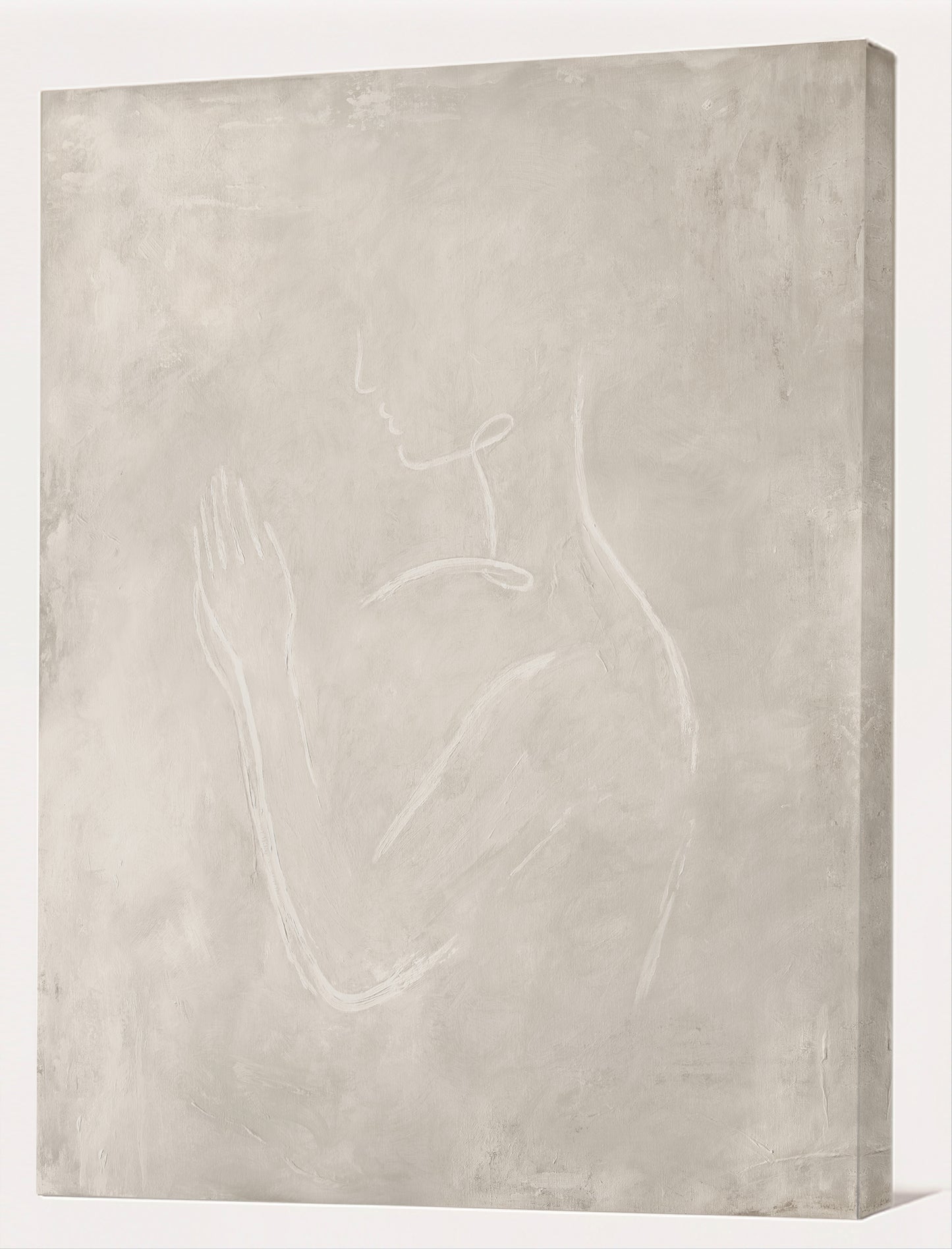
Praying Woman framed canvas print in neutral tones. A woman bows her head with her hands raised in prayer, her profile drawn in a single unbroken stroke of delicate linework. A palette of linen beige and soft ivory brings warmth. A vertical piece designed for rooms that value calm, feminine, neutral aesthetics.
"Blessed is she who believed that the Lord would fulfill His promises to her."—Luke 1:45
✦ Ready to Hang with pre-installed hanging wire. Frame depth 2 inches. The No Frame option is mounted on stretcher wood bars
✦ Made in the USA 🇺🇸
Proudly handcrafted in our Los Angeles art studio
✦ Fast Shipping — Same Day!
Orders placed before noon EST ship same day
✦ Easy Delivery
Free Shipping ✓ Protective Packaging ✓ 100% Insured ✓ Ships to All 50 States & Worldwide ✓ Zero Risk ✓
Art Details
Designed for homes that value clean neutral aesthetics first and quiet faith second. The figure is rendered in barely a dozen ivory strokes that half-dissolve into the warm field, so this praying woman painting reads as contemporary fine-art figurative drawing, at home in modern, minimalist, boho, classic, and farmhouse interiors, while carrying scripture for the woman who wants her faith reflected in her home. It makes a quiet, meaningful gift for a woman of faith, a mother, or a daughter, for a confirmation, a baptism, or a women's faith milestone.
- Subject: a praying woman in profile, open hands lifted in quiet devotion, inspired by Luke 1:45, "Blessed is she who believed that the Lord would fulfill His promises to her." Captures the universal moment of feminine prayer rather than a specific scriptural figure.
- Style: modern, minimalist, fine-art figurative line drawing
- Palette: linen beige, soft ivory, warm cream
- Orientation: vertical
- Best for: prayer corners, bedroom side walls, dressing areas, reading nooks, entryways, primary bathrooms, hallways, tall alcoves, women's ministry rooms, gallery walls
- Material: archival-grade canvas, giclée print with fade-resistant inks for heirloom-quality color retention
- Frame: handcrafted wood, 2-inch depth. No Frame option is gallery-wrapped on solid stretcher bars.
-
Sizes: 12×16, 24×32, 36×48, and 45×60 inches.
Custom size? email us!
help@christianmodern.shop - Frame finishes: Light Wood, Brown Wood, Gold, Black, or No Frame
- Made in: Los Angeles, California, USA
- Includes: pre-installed hanging wire, arrives ready to hang out of the box
- Most-gifted occasions: confirmations, baptisms, women's birthdays, bridal showers, anniversaries, a new home or new chapter, answered prayers, gifts for mothers and daughters, and women's faith milestones
Shipping, Exchanges, Returns & Trust
- Free shipping across all 50 US states and worldwide
- Same-day shipping on orders placed before noon EST
- Delivery time: 3 to 5 business days
- 100% insured with protective packaging
- Exchanges and returns: accepted within 30 days of delivery for your peace of mind
For support in the rare case of delivery damage, email help@christianmodern.shop.
About Luke 1:45 & Blessed Is She Who Believed
Luke 1:45 is spoken by Elizabeth to her younger cousin Mary during the moment Christians call the Visitation: "Blessed is she who believed that the Lord would fulfill His promises to her." The verse celebrates the woman who trusts God's word, not the woman who has every answer, but the woman who keeps believing while she waits.
The verse holds a remarkable distinction: it is the first beatitude of the New Testament. Elizabeth's "blessed is she", the Greek makaria, is the first "blessed" pronouncement in the Gospels, spoken before Jesus ever preaches the Beatitudes, and it uses the same Greek root He will later use on the mount. The first person the New Testament calls blessed is a woman who believed.
Across Catholic, Orthodox, and Protestant traditions, the verse is read at Marian feast days, confirmations, and women's milestone moments, and carried as a personal anchor by Christian women in seasons of hope, waiting, and quiet faith. The painting steps back from the specific figure of Mary and instead captures the universal posture of feminine prayer, every woman who has ever raised her hands in trust.
The composition is rendered in modern figurative line drawing, a tradition that runs from Henri Matisse's mid-century figures to today's neutral-palette minimalist figure art. The pared-back style lets the gesture do the speaking: the bowed head, the raised hands, the breath held in faith.
Praying Woman Common Questions
What does the Bible say about Luke 1:45 and "Blessed is she who believed"?
Luke 1:45 reads: "Blessed is she who believed that the Lord would fulfill His promises to her." The words are spoken by Elizabeth to her younger cousin Mary at the Visitation, in the opening chapter of the Gospel of Luke. Elizabeth, six months pregnant with John the Baptist and filled with the Holy Spirit, recognizes Mary's role in God's plan and praises the faith Mary showed when the angel Gabriel announced she would carry the Messiah. The verse also holds a remarkable distinction: it is the first beatitude of the New Testament. Elizabeth's "blessed is she," the Greek makaria, is the first "blessed" pronouncement in the Gospels, spoken before Jesus ever preaches the Beatitudes and built on the same Greek root, makarios, that He later uses on the mount. While the verse is spoken specifically about Mary, Christian commentators across Catholic, Orthodox, and Protestant traditions read it as a universal blessing on any believer who trusts God's promises before seeing them fulfilled.
What does "Blessed is she who believed" mean spiritually for women today?
Spiritually, "Blessed is she who believed" affirms that faith itself, not certainty, not control, not having every answer, is what God honors. The verse celebrates the woman who keeps trusting God's word in the waiting, before the promise is fulfilled. For modern Christian women, the phrase has become a personal anchor through seasons of hope, infertility, motherhood, career transition, grief, and answered prayer. The Praying Woman canvas was painted to capture this universal posture of feminine prayer, the bowed head, the raised hands, the breath held in faith, rather than a specific scriptural figure, so the verse meaning carries to any woman who has ever raised her hands in trust.
Is the Praying Woman canvas a good gift for a Christian woman, mom, or daughter?
Yes. The Praying Woman canvas is one of Christian Modern's most-gifted pieces for women, chosen for confirmations, baptisms, women's birthdays, bridal showers, anniversaries, gifts for mothers, and milestones like a new home, a new chapter, or an answered prayer. The neutral beige and ivory palette and modern figurative line-drawing style make it an aesthetically safe gift even when you don't know the recipient's decor preferences. It reads as contemporary fine-art figurative drawing first and Christian art second, which is why it works equally well for a sister-in-law you're still getting to know, a mother who values understated faith, or a daughter starting her first apartment. The 24x32 inch ($330 framed) suits a bedside or dresser, and the 36x48 inch ($480 framed) makes a feature-wall gift.
What home aesthetics and rooms does the Praying Woman canvas fit?
The Praying Woman canvas is painted in a soft beige and ivory palette with modern figurative linework, designed to read as contemporary fine-art figure drawing first and Christian art second. It fits minimalist, Japandi, modern boho, Scandinavian, farmhouse, French country, and contemporary feminine interiors, anywhere a quiet, neutral, feminine focal point belongs. The vertical orientation makes it ideal for prayer corners, bedroom side walls and dressing walls, reading nooks, dressing rooms, entryways, primary bathrooms, narrow walls between windows, hallways, and tall alcoves where a horizontal canvas would float. Because the figure is rendered as a universal woman rather than a specific scriptural portrait, the piece carries scripture quietly enough that it works in homes that value calm neutral aesthetics over overt religious decor.
What size Praying Woman canvas should I get for a bedroom, prayer corner, or above a console table?
The Praying Woman canvas comes in four vertical sizes: 12x16 inches ($150 framed), 24x32 inches ($330 framed), 36x48 inches ($480 framed), and 45x60 inches ($750 framed). The 36x48 and 45x60 inch are the two often chosen sizes for this design, with the 45x60 inch the statement, heirloom-scale anchor for a primary bedroom, prayer corner, or high-ceiling entryway. The general decor rule is that wall art above furniture should be two-thirds to three-quarters the width of the piece below, with the canvas centered near standard eye height. For a small reading nook, vanity, or prayer-corner shelf, 12x16 inches works well; for a bedside, dresser, or small dressing wall, 24x32 inches is the right scale; and above a standard console table or sideboard (about 48 inches wide) or a bedroom side wall, 36x48 inches is the natural fit.
Does the Praying Woman painting show Mary at the Visitation, or a universal woman in prayer?
The Praying Woman painting depicts a universal woman in prayer, a woman in profile with open hands raised in quiet devotion, not a specific portrait of Mary at the Visitation. While the painting is inspired by Luke 1:45, which Elizabeth speaks to Mary, the composition is deliberately abstract and feminine rather than iconographically Marian. There is no halo, no biblical-era robe, no specific scene staging. The face is rendered as a single unbroken line of profile rather than a recognizable portrait, the form is contemporary rather than period, and the palette is modern beige and ivory rather than the deep blues and reds traditionally used in Visitation iconography. This is intentional: the painting was made so that any woman of faith could see herself in the figure, regardless of denomination or familiarity with Marian art. If you are looking specifically for a Visitation icon or a traditional portrait of Mary, this is not that piece, but as contemporary modern Christian wall art capturing the universal moment of feminine prayer, it serves both Catholic and Protestant women equally.
Who made the Praying Woman painting and what is it inspired by?
Christian Modern handcrafts every Praying Woman canvas in their Los Angeles, California studio, where the painting was designed in-house as part of the brand's modern Christian wall art collection. The figurative line-drawing style draws from the modern figurative tradition rooted in Henri Matisse's mid-century single-line figures and continued by today's neutral-palette feminine wall art; the entire form is built from roughly a dozen ivory strokes that half-dissolve into the warm beige field, letting the gesture of prayer do the speaking. The piece is printed with archival-grade giclee inks on heavyweight cotton canvas for heirloom-quality color retention, then framed in handcrafted Light Wood, Brown Wood, Gold, or Black finishes, or gallery-wrapped on solid pine stretcher bars for the No Frame option.