
Skip to product information
1 of 14

Cross On The Hill — Soft Blue

Cross On The Hill — Soft Blue

Regular price $150
Regular price $150 Sale price $150
SALE Sold out
Select Framing
Select Size (W x H) inches:

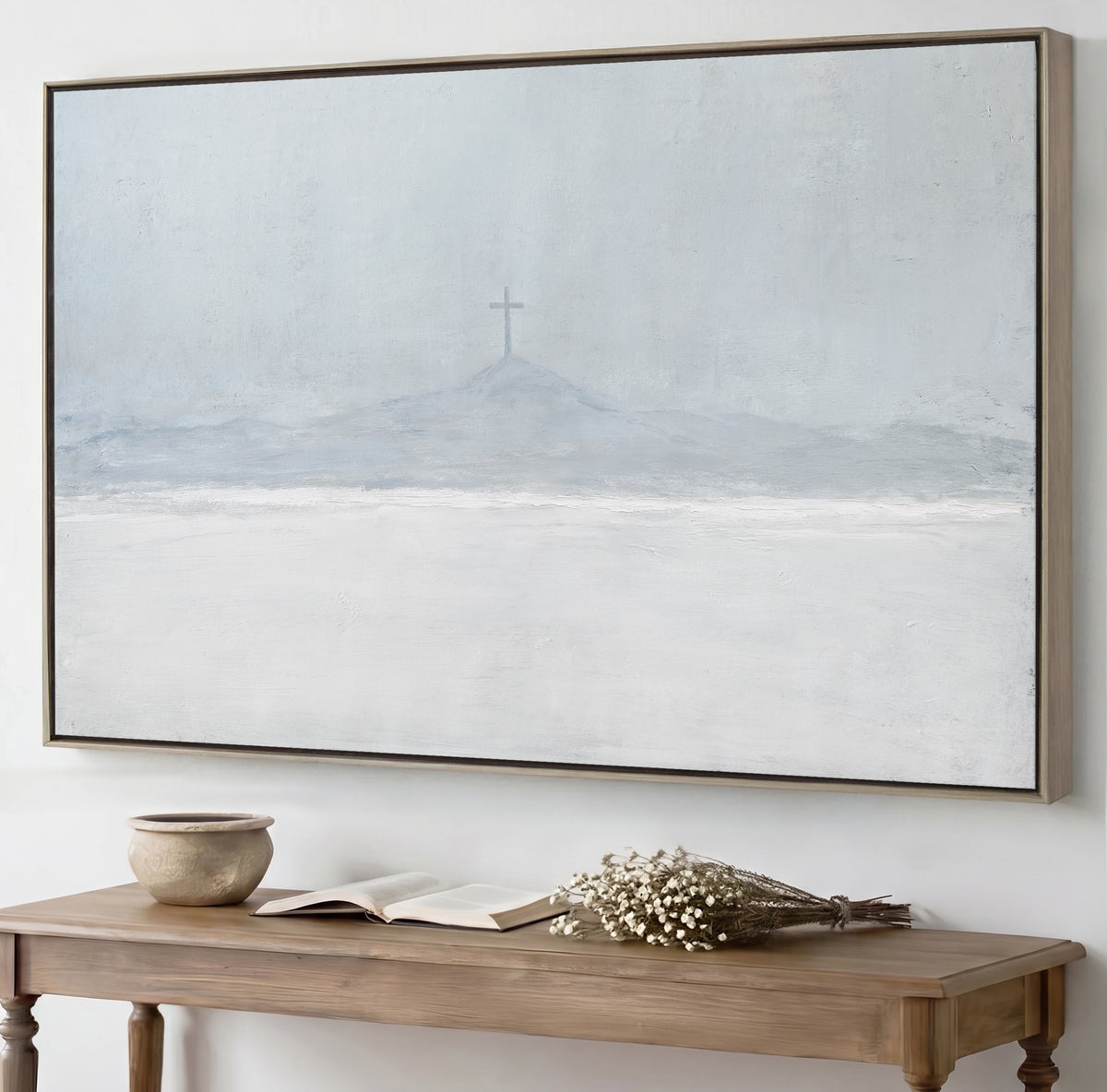
Cross On The Hill framed canvas print in soft blue and off-white tones. The cross stands high on the hill of Calvary, Galatians 2:20. The summit rising above a delicate band of ivory at the horizon. A neutral palette of soft blue and off-white infuses peace and calm into the landscape.

"I have been crucified with Christ and I no longer live, but Christ lives in me."
—Galatians 2:20

✦ Beige Version here

✦ Ready to Hang with pre-installed hanging wire. Frame depth 2 inches. The No Frame option is mounted on stretcher wood bars.

✦ Made in the USA 🇺🇸
Proudly handcrafted in our Los Angeles art studio

✦ Fast Shipping — Same Day!
Orders placed before noon EST ship same day

✦ Easy Delivery
Free Shipping ✓ Protective Packaging ✓ 100% Insured ✓ Ships to All 50 States & Worldwide ✓ Zero Risk ✓

Art Details

Designed for homes that value clean, neutral aesthetics first, and carry faith quietly but unmistakably. The cross is drawn in soft slate blue and set deep in the haze. Cross On The Hill — Soft Blue was made for home offices and studies, bedrooms, hallways, entryways, reading nooks, and quiet corners, and pairs naturally with pale oak, black metal, linen, concrete, and cool-toned whites across Japandi, Scandinavian, cool minimalist, contemporary, and modern transitional interiors.

  • Subject: a cross standing on the hill of Calvary, called Golgotha in Matthew, Mark, and John, half-veiled in morning mist. Painted to Galatians 2:20, "I have been crucified with Christ and I no longer live, but Christ lives in me." A risen, empty cross.
  • Style: modern, minimalist, atmospheric landscape with heavy plaster-like impasto and palette-knife brushwork
  • Palette: soft slate blue, pale sky blue, dusty gray-blue, chalk white
  • Orientation: horizontal
  • Best for: home offices and studies, bedrooms, hallways, entryways, reading nooks, guest rooms, quiet corners, gallery walls
  • Material: archival-grade canvas, giclée print with fade-resistant inks
  • Frame: handcrafted wood, 2-inch depth. No Frame option ships gallery-wrapped on wood stretcher bars
  • Sizes: 18×12, 30×20, 48×32, and 60×40 inches
    Custom size? email us!
    Custom size up to 100x50 inches
    help@christianmodern.shop
  • Frame finishes: Light Wood, Brown Wood, Gold, Black, or No Frame
  • Made in: Los Angeles, California, USA
  • Includes: pre-installed hanging wire, arrives ready to hang out of the box
  • Most-gifted occasions: confirmation, baptism, Lent and Holy Week, graduation, ordination and seminary gifts, a new home or new chapter, men's faith milestones, and gifts for a son, husband, or father

Shipping, Exchanges, Returns & Trust

  • Free shipping across all 50 US states and worldwide
  • Same-day shipping on orders placed before noon EST
  • Delivery time: 3 to 5 business days
  • 100% insured with protective packaging
  • Exchanges and returns: accepted within 30 days of delivery for your peace of mind

For support in the rare case of delivery damage, email help@christianmodern.shop.

About Galatians 2:20 and the Risen Cross

Galatians 2:20 is one of the most personally held sentences in the New Testament: "I have been crucified with Christ and I no longer live, but Christ lives in me. The life I now live in the body, I live by faith in the Son of God, who loved me and gave Himself for me." Paul is writing to the churches of Galatia, and the Greek verb he chooses for "I have been crucified," synestauromai, sits in the perfect tense, which describes a completed action whose effect is still running. Not "I was crucified," and not "I am being crucified." Something finished that keeps working.

That tense is the reason this verse belongs on this painting. Galatians 2:20 is not about the hour on the hill so much as what the hill keeps doing in a person afterward, quietly, on ordinary days. The cross here stands at a distance, half-taken by mist, present rather than announced, which is how Paul describes it living in him.

The cross is shown risen and empty, and that is the oldest convention in Christian art. Long before the crucifix became common in the Western church, Christians painted the cross alone as a sign of victory: the crux gemmata of the fifth century, the gold cross Theodosius II raised on the rock of Golgotha in AD 420, the luminous cross in the apse of Sant'Apollinare in Classe at Ravenna, all of them without a corpus, all of them meant to show not the historicity of the crucifixion but its meaning, that Christ has conquered death. The empty cross remains the form most at home in Protestant and evangelical settings, and it belongs to the whole church, appearing across Catholic, Orthodox, and Protestant spaces alike.

The palette keeps the same restraint. Soft slate blue, pale sky blue, and chalk white are built in heavy plaster-like impasto, a surface drawn from the wabi-sabi and cool-minimalist tradition, where the texture of the painting does as much work as the image on it. The haze is not weather. It is the distance between the viewer and the hill.

Cross On The Hill Soft Blue Common Questions

What does Galatians 2:20 mean?
Galatians 2:20 reads: "I have been crucified with Christ and I no longer live, but Christ lives in me. The life I now live in the body, I live by faith in the Son of God, who loved me and gave Himself for me." Paul is writing to the churches of Galatia, arguing that a person is made right with God through faith in Christ rather than through keeping the law, and this verse is his most personal statement of what that means. The Greek verb he uses for "I have been crucified," synestauromai, sits in the perfect tense, which describes an action completed in the past whose effect continues into the present. Paul is not describing a feeling or an ongoing struggle but a settled fact with ongoing force: the old self died with Christ at Calvary, and what animates him now is Christ living in him. It is one of the clearest New Testament statements of union with Christ, and one of the most quoted verses in modern Christian life.

What does the empty cross mean in Christian art?
The empty cross, also called the risen cross, is a cross shown without a figure on it, and it is the oldest form in Christian art. Early Christians painted the cross alone as a sign of triumph rather than as a record of suffering. Around AD 400 the apse mosaic of Santa Pudenziana in Rome shows a gold and jewelled cross, a crux gemmata, standing on a hill against a panorama of Jerusalem, and in AD 420 the emperor Theodosius II raised a real one on the rock of Golgotha where pilgrims came to pray. The same luminous gold cross glows from the apse of Sant'Apollinare in Classe at Ravenna, and processional crosses across the early medieval church were made the same way, without a corpus. The crucifix, which includes the figure of Christ, carries the moment of the cross and remains the standard form in Catholic and Orthodox practice, while the empty cross carries what followed and became the dominant form in Protestant churches after the Reformation. Cross On The Hill shows the risen cross, which is why it sits easily in Protestant, evangelical, and non-denominational homes, and works in Catholic homes as a Calvary landscape.

Why choose the Soft Blue version, what do the blue tones represent, and what rooms does it suit?
The Soft Blue version is the cooler and quieter of the two colorways, built on soft slate blue, pale sky blue, dusty gray-blue, and chalk white. The palette is doing the work of the meaning: blue is the color of the hour before dawn and of distance seen across open ground, and the haze that half-takes the cross is not weather but the space between the viewer and the hill. It suits homes that run cool, with pale oak, ash, black metal, concrete, glass, brushed nickel, and cool-toned whites, and it belongs in Japandi, Scandinavian, cool minimalist, contemporary, and modern transitional interiors. The heavy plaster-like texture keeps it from reading flat or corporate, so it holds a wall in a study or home office where a warmer piece would sit oddly. If your home runs warm with oak, travertine, brass, jute, and cream walls, the Beige Cross On The Hill is the better match.

What size canvas works above a desk, console table, or in an entryway?
The general rule is that wall art above furniture should be two-thirds to three-quarters the width of the piece below it, with the center of the canvas roughly 58 inches from the floor. Cross On The Hill Soft Blue comes in four horizontal sizes: 18x12 inches ($150 framed), 30x20 inches ($330 framed), 48x32 inches ($480 framed), and 60x40 inches ($750 framed). For a desk wall, study, reading nook, or narrow hallway, the 30x20 inch is the right scale. Above a standard console table or sideboard of about 48 inches, or on a home-office feature wall, the 48x32 inch is the natural fit. The 60x40 inch is the statement size for an entryway with height, a great room, or a large office wall. The 18x12 inch works within a gallery wall or a small guest room.

Is the Soft Blue version a good gift?
Yes, and it is the quieter and more contemplative of the two colorways, which makes it the right choice for a home that runs cool or a recipient whose taste is restrained. The soft slate blue and chalk white palette and the discipleship register of Galatians 2:20 suit confirmations, baptisms, graduations, ordinations and seminary milestones, and a new home or new chapter. It is also one of the easier Christian gifts to give a man, which is a genuinely hard category: the piece reads as an atmospheric minimalist landscape, so it works for a son, a husband, a father, or a brother whose walls would not otherwise carry a religious print. The 30x20 inch ($330 framed) suits a desk wall or study, and the 48x32 inch ($480 framed) anchors an office or living room.

Will the soft blue and chalk white tones stay true over time?
Yes. Every canvas is printed with archival giclee inks on museum-quality heavyweight cotton, made to resist fading and color shift in normal indoor light. That archival standard matters most for a pale, low-contrast palette like this one, where even slight yellowing would warm the blues and change the mood of the whole piece, so the slate blue, pale sky blue, and chalk white hold exactly as painted. The heavy plaster-like impasto and palette-knife texture are reproduced at full tonal depth, which is what keeps the misty summit reading as depth rather than as flat grey. Each canvas is made to order in the Christian Modern studio in Los Angeles, California.

Is Cross On The Hill suited to Lent, Good Friday, and Easter?
Yes, and it is built to stay on the wall long after. Cross On The Hill Soft Blue is a Calvary landscape in a quiet register, which makes it a natural piece for Lent, Holy Week, Good Friday, and Easter, and a thoughtful Easter, baptism, or confirmation gift. Galatians 2:20 anchors it to ordinary daily life rather than to one week of the church calendar, so it belongs on the wall in February and in August just as much as in April. That is what makes it work as a seasonal gift: the recipient keeps it up. Many buyers pair it with the warm neutral and gold version and move the two between rooms through the year.

How is the Soft Blue canvas framed, and does it arrive ready to hang?
Every framed piece arrives ready to hang out of the box with pre-installed hanging wire and a handcrafted 2-inch wood frame in Light Wood, Brown Wood, Gold, or Black; the Light Wood and Black finishes pair most naturally with this cool blue palette. The No Frame option ships gallery-wrapped on solid wood stretcher bars and hangs directly. Cross On The Hill Soft Blue is an original modern Calvary landscape by Christian Modern, built in heavy plaster-like impasto and palette-knife strokes drawn from the wabi-sabi and cool-minimalist painting tradition, made to order in our Los Angeles studio. It ships within one business day with free, fully insured delivery across all 50 states and worldwide, and exchanges and returns are accepted within 30 days of delivery for your peace of mind.

View full details

Cross On The Hill framed canvas print in soft blue and off-white tones. The cross stands high on the hill of Calvary, Galatians 2:20. The summit rising above a delicate band of ivory at the horizon. A neutral palette of soft blue and off-white infuses peace and calm into the landscape.

"I have been crucified with Christ and I no longer live, but Christ lives in me."
—Galatians 2:20

✦ Beige Version here

✦ Ready to Hang with pre-installed hanging wire. Frame depth 2 inches. The No Frame option is mounted on stretcher wood bars.

✦ Made in the USA 🇺🇸
Proudly handcrafted in our Los Angeles art studio

✦ Fast Shipping — Same Day!
Orders placed before noon EST ship same day

✦ Easy Delivery
Free Shipping ✓ Protective Packaging ✓ 100% Insured ✓ Ships to All 50 States & Worldwide ✓ Zero Risk ✓

Art Details

Designed for homes that value clean, neutral aesthetics first, and carry faith quietly but unmistakably. The cross is drawn in soft slate blue and set deep in the haze. Cross On The Hill — Soft Blue was made for home offices and studies, bedrooms, hallways, entryways, reading nooks, and quiet corners, and pairs naturally with pale oak, black metal, linen, concrete, and cool-toned whites across Japandi, Scandinavian, cool minimalist, contemporary, and modern transitional interiors.

  • Subject: a cross standing on the hill of Calvary, called Golgotha in Matthew, Mark, and John, half-veiled in morning mist. Painted to Galatians 2:20, "I have been crucified with Christ and I no longer live, but Christ lives in me." A risen, empty cross.
  • Style: modern, minimalist, atmospheric landscape with heavy plaster-like impasto and palette-knife brushwork
  • Palette: soft slate blue, pale sky blue, dusty gray-blue, chalk white
  • Orientation: horizontal
  • Best for: home offices and studies, bedrooms, hallways, entryways, reading nooks, guest rooms, quiet corners, gallery walls
  • Material: archival-grade canvas, giclée print with fade-resistant inks
  • Frame: handcrafted wood, 2-inch depth. No Frame option ships gallery-wrapped on wood stretcher bars
  • Sizes: 18×12, 30×20, 48×32, and 60×40 inches
    Custom size? email us!
    Custom size up to 100x50 inches
    help@christianmodern.shop
  • Frame finishes: Light Wood, Brown Wood, Gold, Black, or No Frame
  • Made in: Los Angeles, California, USA
  • Includes: pre-installed hanging wire, arrives ready to hang out of the box
  • Most-gifted occasions: confirmation, baptism, Lent and Holy Week, graduation, ordination and seminary gifts, a new home or new chapter, men's faith milestones, and gifts for a son, husband, or father

Shipping, Exchanges, Returns & Trust

  • Free shipping across all 50 US states and worldwide
  • Same-day shipping on orders placed before noon EST
  • Delivery time: 3 to 5 business days
  • 100% insured with protective packaging
  • Exchanges and returns: accepted within 30 days of delivery for your peace of mind

For support in the rare case of delivery damage, email help@christianmodern.shop.

About Galatians 2:20 and the Risen Cross

Galatians 2:20 is one of the most personally held sentences in the New Testament: "I have been crucified with Christ and I no longer live, but Christ lives in me. The life I now live in the body, I live by faith in the Son of God, who loved me and gave Himself for me." Paul is writing to the churches of Galatia, and the Greek verb he chooses for "I have been crucified," synestauromai, sits in the perfect tense, which describes a completed action whose effect is still running. Not "I was crucified," and not "I am being crucified." Something finished that keeps working.

That tense is the reason this verse belongs on this painting. Galatians 2:20 is not about the hour on the hill so much as what the hill keeps doing in a person afterward, quietly, on ordinary days. The cross here stands at a distance, half-taken by mist, present rather than announced, which is how Paul describes it living in him.

The cross is shown risen and empty, and that is the oldest convention in Christian art. Long before the crucifix became common in the Western church, Christians painted the cross alone as a sign of victory: the crux gemmata of the fifth century, the gold cross Theodosius II raised on the rock of Golgotha in AD 420, the luminous cross in the apse of Sant'Apollinare in Classe at Ravenna, all of them without a corpus, all of them meant to show not the historicity of the crucifixion but its meaning, that Christ has conquered death. The empty cross remains the form most at home in Protestant and evangelical settings, and it belongs to the whole church, appearing across Catholic, Orthodox, and Protestant spaces alike.

The palette keeps the same restraint. Soft slate blue, pale sky blue, and chalk white are built in heavy plaster-like impasto, a surface drawn from the wabi-sabi and cool-minimalist tradition, where the texture of the painting does as much work as the image on it. The haze is not weather. It is the distance between the viewer and the hill.

Cross On The Hill Soft Blue Common Questions

What does Galatians 2:20 mean?
Galatians 2:20 reads: "I have been crucified with Christ and I no longer live, but Christ lives in me. The life I now live in the body, I live by faith in the Son of God, who loved me and gave Himself for me." Paul is writing to the churches of Galatia, arguing that a person is made right with God through faith in Christ rather than through keeping the law, and this verse is his most personal statement of what that means. The Greek verb he uses for "I have been crucified," synestauromai, sits in the perfect tense, which describes an action completed in the past whose effect continues into the present. Paul is not describing a feeling or an ongoing struggle but a settled fact with ongoing force: the old self died with Christ at Calvary, and what animates him now is Christ living in him. It is one of the clearest New Testament statements of union with Christ, and one of the most quoted verses in modern Christian life.

What does the empty cross mean in Christian art?
The empty cross, also called the risen cross, is a cross shown without a figure on it, and it is the oldest form in Christian art. Early Christians painted the cross alone as a sign of triumph rather than as a record of suffering. Around AD 400 the apse mosaic of Santa Pudenziana in Rome shows a gold and jewelled cross, a crux gemmata, standing on a hill against a panorama of Jerusalem, and in AD 420 the emperor Theodosius II raised a real one on the rock of Golgotha where pilgrims came to pray. The same luminous gold cross glows from the apse of Sant'Apollinare in Classe at Ravenna, and processional crosses across the early medieval church were made the same way, without a corpus. The crucifix, which includes the figure of Christ, carries the moment of the cross and remains the standard form in Catholic and Orthodox practice, while the empty cross carries what followed and became the dominant form in Protestant churches after the Reformation. Cross On The Hill shows the risen cross, which is why it sits easily in Protestant, evangelical, and non-denominational homes, and works in Catholic homes as a Calvary landscape.

Why choose the Soft Blue version, what do the blue tones represent, and what rooms does it suit?
The Soft Blue version is the cooler and quieter of the two colorways, built on soft slate blue, pale sky blue, dusty gray-blue, and chalk white. The palette is doing the work of the meaning: blue is the color of the hour before dawn and of distance seen across open ground, and the haze that half-takes the cross is not weather but the space between the viewer and the hill. It suits homes that run cool, with pale oak, ash, black metal, concrete, glass, brushed nickel, and cool-toned whites, and it belongs in Japandi, Scandinavian, cool minimalist, contemporary, and modern transitional interiors. The heavy plaster-like texture keeps it from reading flat or corporate, so it holds a wall in a study or home office where a warmer piece would sit oddly. If your home runs warm with oak, travertine, brass, jute, and cream walls, the Beige Cross On The Hill is the better match.

What size canvas works above a desk, console table, or in an entryway?
The general rule is that wall art above furniture should be two-thirds to three-quarters the width of the piece below it, with the center of the canvas roughly 58 inches from the floor. Cross On The Hill Soft Blue comes in four horizontal sizes: 18x12 inches ($150 framed), 30x20 inches ($330 framed), 48x32 inches ($480 framed), and 60x40 inches ($750 framed). For a desk wall, study, reading nook, or narrow hallway, the 30x20 inch is the right scale. Above a standard console table or sideboard of about 48 inches, or on a home-office feature wall, the 48x32 inch is the natural fit. The 60x40 inch is the statement size for an entryway with height, a great room, or a large office wall. The 18x12 inch works within a gallery wall or a small guest room.

Is the Soft Blue version a good gift?
Yes, and it is the quieter and more contemplative of the two colorways, which makes it the right choice for a home that runs cool or a recipient whose taste is restrained. The soft slate blue and chalk white palette and the discipleship register of Galatians 2:20 suit confirmations, baptisms, graduations, ordinations and seminary milestones, and a new home or new chapter. It is also one of the easier Christian gifts to give a man, which is a genuinely hard category: the piece reads as an atmospheric minimalist landscape, so it works for a son, a husband, a father, or a brother whose walls would not otherwise carry a religious print. The 30x20 inch ($330 framed) suits a desk wall or study, and the 48x32 inch ($480 framed) anchors an office or living room.

Will the soft blue and chalk white tones stay true over time?
Yes. Every canvas is printed with archival giclee inks on museum-quality heavyweight cotton, made to resist fading and color shift in normal indoor light. That archival standard matters most for a pale, low-contrast palette like this one, where even slight yellowing would warm the blues and change the mood of the whole piece, so the slate blue, pale sky blue, and chalk white hold exactly as painted. The heavy plaster-like impasto and palette-knife texture are reproduced at full tonal depth, which is what keeps the misty summit reading as depth rather than as flat grey. Each canvas is made to order in the Christian Modern studio in Los Angeles, California.

Is Cross On The Hill suited to Lent, Good Friday, and Easter?
Yes, and it is built to stay on the wall long after. Cross On The Hill Soft Blue is a Calvary landscape in a quiet register, which makes it a natural piece for Lent, Holy Week, Good Friday, and Easter, and a thoughtful Easter, baptism, or confirmation gift. Galatians 2:20 anchors it to ordinary daily life rather than to one week of the church calendar, so it belongs on the wall in February and in August just as much as in April. That is what makes it work as a seasonal gift: the recipient keeps it up. Many buyers pair it with the warm neutral and gold version and move the two between rooms through the year.

How is the Soft Blue canvas framed, and does it arrive ready to hang?
Every framed piece arrives ready to hang out of the box with pre-installed hanging wire and a handcrafted 2-inch wood frame in Light Wood, Brown Wood, Gold, or Black; the Light Wood and Black finishes pair most naturally with this cool blue palette. The No Frame option ships gallery-wrapped on solid wood stretcher bars and hangs directly. Cross On The Hill Soft Blue is an original modern Calvary landscape by Christian Modern, built in heavy plaster-like impasto and palette-knife strokes drawn from the wabi-sabi and cool-minimalist painting tradition, made to order in our Los Angeles studio. It ships within one business day with free, fully insured delivery across all 50 states and worldwide, and exchanges and returns are accepted within 30 days of delivery for your peace of mind.